

Comparing Pop-Up Displays

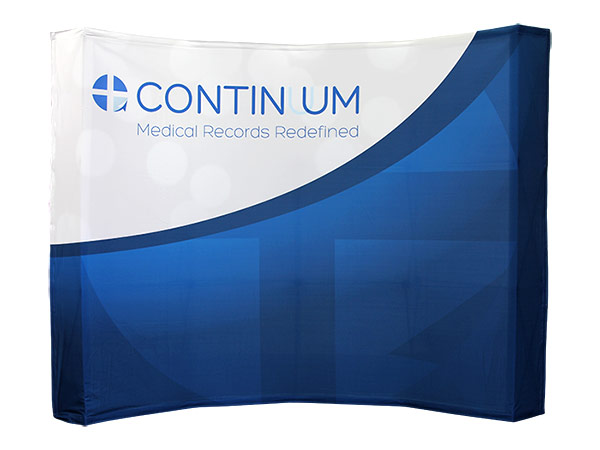
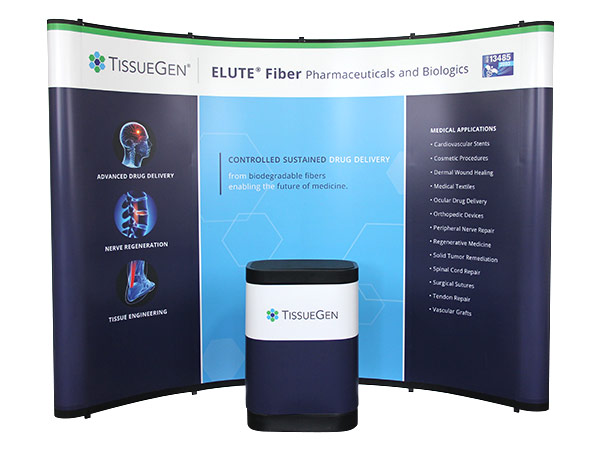
Quick answer: Pop-up displays come in two main styles. Laminated pop-ups hang several rigid graphic panels side by side and give the sharpest, most vivid print. Fabric pop-ups, which we call Burst Displays, use one seamless fabric graphic that stays on the frame, so they set up faster. Both are good choices. The style to avoid is a direct print on thin plastic paired with a cheap imported frame.
Why do pop-up displays vary so much in price?
Because pop-up displays are so popular in the trade show industry, dozens of manufacturers produce them. The result is a wide range in both price and quality. There are many extremely cheap pop-ups produced overseas that are easy to damage and difficult to work with. There are also several high quality, American-made pop-up displays available, and you can expect to pay a higher price for them.
What do you get with an American-made pop-up frame?
- Warranty and parts. American-made frames typically come with a lifetime warranty, and if you ever need a replacement part you can easily contact the manufacturer.
- Clear instructions. Imported frames often have setup instructions that are difficult to understand, or none at all. Displays made in the USA typically have clear, easy to follow instructions.
- Better shipping cases. The cases are much more heavy duty, so they do a better job of protecting your display in shipping and help you avoid costly damage.
What are the three types of pop-up graphics?
The graphics matter at least as much as the frame. There are three main categories of printed graphics used on pop-up displays.
1. Laminated graphic panels
This is the highest quality option. The graphic is printed on premium satin photo paper and then thermally laminated. Our laminated panels have a slightly textured, glare and fingerprint resistant top laminate and a light blocking backer. The finished panel is semi-rigid, yet it can still be rolled for shipping. Because it is a photo print, details are the most crisp and colors are the most accurate and vivid.
With laminated panels, your backdrop is tiled from several vertical strips, each roughly 2.5 feet wide depending on the frame. The panels hang from the top of the frame side by side, and the result looks like one continuous graphic.
2. Dye-sublimated fabric graphics
Fabric pop-ups use a similar frame, with a couple of essential differences. The graphic is printed on a single piece of fabric that typically attaches to the frame with Velcro. Because the fabric needs to be pulled tight, these frames use connector hooks that are attached and released as the frame is set up and taken down.
Other than that, setup is extremely simple, because the graphic stays on the frame during shipping and storage. Fabric prints are generally slightly less crisp and not quite as vivid as laminated panels, but the overall quality is still impressive, and from a distance the difference can be almost impossible to see. To set them apart from our laminated pop-ups, we call our fabric pop-ups Burst Displays.
3. Direct print on styrene or thin plastic
This is the cheapest way to produce a pop-up graphic, so it is often paired with a cheaply made imported frame to keep the price down. Direct prints are made on flatbed printers rather than large-format photo printers, so the print is typically grainier with less accurate color, and the material is prone to curling, cracking and fading. Direct print is a great way to print on rigid materials, but we do not recommend it for pop-up displays and we do not offer it.
Laminated vs. fabric vs. direct print at a glance
| Laminated panels | Fabric (Burst) | Direct print on styrene | |
|---|---|---|---|
| Graphic | Several panels, each about 2.5 ft wide, hung side by side | One seamless piece of fabric | Several thin plastic panels |
| Print quality | Most crisp and vivid | Slightly softer, very close from a distance | Grainier, less accurate color |
| Setup | Open the frame, then hang each panel | Open the frame; the graphic is already attached | Open the frame, then hang each panel |
| Shipping and storage | Panels roll up in the case | Graphic stays on the collapsed frame | Panels can curl or crack |
| Our take | Best image quality | Fastest setup | Not recommended |
Common questions
Which pop-up display is easiest to set up?
A fabric pop-up. The graphic stays attached to the frame, so you open the frame, attach the connector hooks and you are done.
Which pop-up display has the best print quality?
A laminated pop-up. It is a photo print on satin paper, so detail and color are the best of the three types.
Is a cheap imported pop-up worth it?
Usually not if you plan to use it more than once. Low cost frames are easier to damage, often come without usable instructions or replacement parts, and are frequently sold with direct print graphics that curl, crack and fade.
The most important thing when shopping for a pop-up display is to do your research and make an informed purchase.